
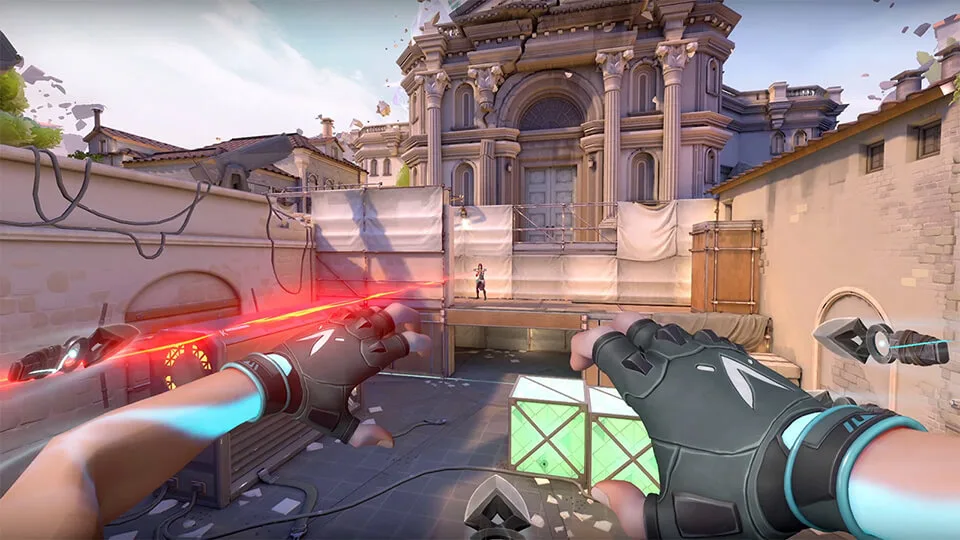
Because it is built as a competitive shooter, Valorant asks very little of your hardware. To help you place your own machine, here are the three standard specs suggested by Riot Games, the studio behind the game.
THE THREE OFFICIAL SPECS
The three tiers listed by Riot Games, with the frame rate each one targets.
| Component | Minimum30 frames per second | Recommended60 frames per second | Performance144 frames per second |
|---|---|---|---|
| OS | Windows 10 or 11, 64-bit | Windows 10 or 11, 64-bit | Windows 10 or 11, 64-bit |
| CPU | Intel Core 2 Duo E8400 or AMD Athlon 200GE |
Intel i3-4150 or AMD Ryzen 1200 |
Intel i5-9400F or AMD Ryzen 5 2600X |
| GPU | Intel HD 4000 or AMD Radeon R5 200 |
NVIDIA GeForce GT 730 or AMD Radeon R7 240 |
NVIDIA GTX 1050 Ti or AMD Radeon R7 370 |
| RAM | 4 GB | 8 GB recommended | 16 GB recommended |
| VRAM | 1 GB | 2 GB recommended | 4 GB recommended |
| Storage | 35 GB or more | 35 GB or more | 35 GB or more |
Minimum requirements
With this setup you can expect around 30 fps (frames per second) with the graphics turned all the way down. It still gives you a perfectly playable game.
Recommended requirements
Built for 60 fps, this setup gives you a smooth game without too many compromises.
Performance requirements
For players who want high visual quality and a steady 144 fps.
Few things are more frustrating than being locked out of your favorite game by your hardware. Riot Games made sure Valorant would reach a wide audience, which is why the bar sits so low. The GTX 1050 Ti is an entry-level graphics card that has been around for more than six years, and it is still enough to aim for 144 frames per second.
One more thing worth knowing: in this game, the CPU is what caps your frame rate before the GPU does once you start chasing high numbers. So there is no point overspending on graphics if the processor cannot keep up.
CHECK YOUR PC IN ONE MINUTE
Before you compare anything, you need to know what is actually inside your machine. Here is the fastest way to find out, with nothing to install.
Open the DirectX Diagnostic Tool
Press Windows + R, type dxdiag and hit Enter. The window opens after a few seconds of scanning.
Write down your CPU and your RAM
On the System tab, the Processor and Memory lines give you the two numbers that matter most. Compare them with the Recommended column in the table above.
Write down your graphics card
Switch to the Display tab. The Name field shows your graphics card, and Display Memory tells you how much VRAM it has.
Check your free disk space
Open File Explorer and look at the space left on the drive where you plan to install the game. Leave yourself comfortable room beyond the 35 GB Riot lists.
If your parts clear the Recommended column, you will play without any trouble. If they land between minimum and recommended, the game runs but you will have to turn the settings down. Below the minimum, it is time to think about a new machine, and the section further down gives you some pointers.
THE WINDOWS 11 CATCH
This is the point most spec sheets leave out, and it is the number one reason the game refuses to launch. The Valorant anti-cheat adds two conditions on Windows 11: TPM 2.0 and Secure Boot have to be present and enabled.
In practice, a machine that looks perfectly capable on paper can refuse to start the game if either option is turned off in the BIOS. Every recent machine supports them, but they are not always on by default, especially on refurbished or secondhand hardware.
Press Windows + R, type msinfo32: BIOS Mode should
read UEFI and Secure Boot State should read
On. Then run the same command with tpm.msc: the
window should say the module is ready for use.
If either check fails, the full walkthrough will be on our page about downloading and installing Valorant.
Worth noting as well: Windows 7, 8 and 8.1 are no longer supported. You now need 64-bit Windows 10 or 11.
VALORANT GRAPHICS SETTINGS
Your hardware is only half of the picture. Understanding the graphics settings in Valorant and dialing them in properly can make just as much of a difference to how you play.
- Texture quality: turning this up makes the game look sharper and more detailed. On an older or entry-level graphics card, though, dialing it back is what buys you smoother frames.
- Detail quality: this one drives how complex the world is, buildings and foliage included. Lowering it can lift your frame rate, at the cost of a plainer looking game.
- Shadows: shadows add depth, but they are expensive. Players chasing a competitive edge often turn them off completely to spot enemies more easily.
- Anti-aliasing: this smooths out jagged edges. It cleans up the image, but it eats into performance. If you feel stutters, turn it down or off.
- V-Sync: this stops screen tearing, but it adds a bit of input lag, which matters a lot in a competitive shooter like Valorant. On a high refresh rate monitor, you are generally better off leaving V-Sync off.
The settings we recommend for competitive
Here is a starting point built around frame rate and readability, to fine-tune afterwards to suit your machine and your taste.
A recommended starting point, weighted toward smooth frames and clear visuals.
| Setting | Recommended value | Why |
|---|---|---|
| Resolution | Your monitor's native | Do not go below it: you lose sharpness without gaining much. |
| Display mode | Fullscreen | Lower display latency than borderless windowed. |
| Texture quality | Low | No effect on enemy visibility, and an instant performance gain. |
| Detail quality | Low | Simplifies the scenery, which actually makes silhouettes easier to read. |
| Cast shadows | Off | Plenty of players turn them off to pick out enemies more easily. |
| Anti-aliasing | Off or MSAA 2x | Only worth switching on if your machine has headroom. |
| Anisotropic filtering | 1x or 2x | Barely visible in a match, and far from free. |
| V-Sync | Off | Adds input lag, a no-go in competitive. |
| Improve clarity | On | Sharpens edges slightly, handy for picking out a silhouette. |
| Bloom and distortion | Off | Purely cosmetic effects that hurt readability. |
Keep in mind that graphics settings come down to personal preference as much as anything else. Some players want the game to look good, others want every last frame. Try these values out and adjust them until they fit your system and your playstyle.
WHAT IF YOUR PC FALLS SHORT?
If your machine sits below the minimum spec, here are the builds we pick to cover the tiers in the table above. The good news: Valorant asks so little that the budget involved stays well below what a machine built for the heaviest games would cost.
On Valorant, your money is usually better spent on a 144 Hz monitor than on an oversized graphics card. A $700 build with a good monitor is more enjoyable than a $1,000 one hooked up to a 60 Hz panel. The full breakdown is in our PC buying guide.
OPTIMIZING YOUR SETUP FOR VALORANT
Have a look at our full guide to optimizing your PC and Windows, to get the best possible experience on Valorant.
And if the problem is not your machine but your connection, our guide to optimizing your ping walks through the network checkup step by step. An unstable ping produces symptoms that often get blamed on a lack of horsepower.
FREQUENTLY ASKED QUESTIONS
What are the minimum requirements for Valorant?
An Intel Core 2 Duo E8400 or AMD Athlon 200GE processor, an Intel HD 4000 or AMD Radeon R5 200 graphics card, 4 GB of RAM and 35 GB of storage, on 64-bit Windows 10 or 11. That setup gets you around 30 frames per second with the graphics turned all the way down, which is playable but far from comfortable in competitive.
What do you need to run Valorant at 144 fps?
Riot lists an Intel i5-9400F or AMD Ryzen 5 2600X, paired with a GTX 1050 Ti or a Radeon R7 370, with 16 GB of RAM recommended. Those parts are several years old now, which puts that tier within reach even secondhand or refurbished.
How do I know if my PC can run Valorant?
Press Windows and R, type dxdiag and hit Enter. The System tab shows your processor and your RAM, the Display tab your graphics card. Compare those three numbers with the table on this page: if you clear the Recommended column, you will play comfortably.
Does Valorant still run on Windows 7 or 8?
No. Those versions are no longer supported and you now need 64-bit Windows 10 or 11. On Windows 11, two extra conditions apply: TPM 2.0 and Secure Boot have to be enabled, otherwise the anti-cheat blocks the game from launching.
Can you play Valorant on a laptop without a dedicated graphics card?
Yes, with no trouble at all on a recent machine. Current processors ship with integrated graphics that comfortably clear a hundred frames per second at 1080p in this game. That is one of the big strengths of Valorant, which was built on purpose to run on a very wide range of machines.
How much disk space should I plan for?
Riot lists 35 GB, but plan for more. The game grows with every act, and the installer needs temporary space to unpack its files. A nearly full drive is in fact a classic reason for an install that fails halfway through.