
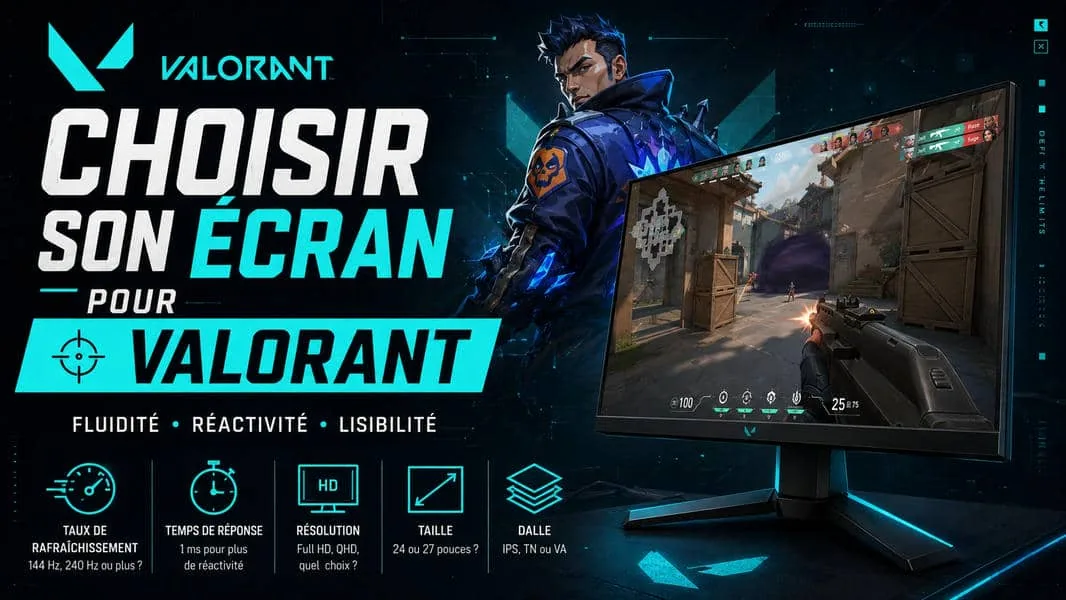
It is without any doubt the hardest peripheral to choose, because a monitor lasts, and you generally go for a well built product so as to make the most of it. In this article, I have chosen to stick to monitors for playing Valorant (and other video games), other uses are left aside.
FORMAT AND SIZE OF THE MONITOR
Aspect ratio
4:3 (four to three) and 16:9 (sixteen to nine) are the ratios that set the proportions of the image. You no longer find 4:3 monitors on the market, 16:9 is what dominates. The other formats known as ultrawide will be worth having on immersive games but not on FPS (first-person shooter) titles.
Without any hesitation, go for a 16:9 monitor!
Screen size
Screen size means the diagonal of the panel, and that diagonal is measured in inches (1 inch = 2.54 cm). There are standards on the gaming monitor market (24", 27", 32"…). And the majority of players, professionals in competition included, play on 24 and 27 inch monitors.
Whatever the diagonal of the monitor you end up choosing, do not forget to account for the distance your field of view needs. The bigger the screen, the further away from you it has to sit. So you need a surface, a desk, with enough depth to make the most of it.
Beyond personal preference, ergonomics play a crucial part in the choice of screen size. According to several ergonomic studies, a screen that is too large or too small can cause eye strain over long gaming sessions. The distance you sit from the screen matters just as much. For a 24 inch monitor, the ideal distance is generally around 80 to 100 cm, roughly 32 to 40 inches, while a 27 inch monitor would be ideal at a distance of around 100 to 120 cm, roughly 40 to 47 inches. So make sure you choose a screen size that suits your play space.
MONITOR RESOLUTION (SOMETIMES CALLED DEFINITION)
If HD, Full HD, QHD or even 4K sound like gibberish to you, I am going to explain it all and help you choose properly. In everyday speech, definition and resolution are used for one and the same thing. What is being described is the number of dots, or pixels (picture elements), that a monitor can display. It is the product of the number of dots across the width by the number of dots down the height of the display. Which gives: 1280×720 (HD), 1920×1080 (Full HD, or 1080p), 2560×1440 (QHD, 2K or 1440p), 3840×2160 (Ultra HD or 4K), and that list is not exhaustive, since other intermediate resolutions exist.
The higher the resolution, the more pixels the image holds, and so the better the quality and the fidelity. A high resolution does however call for a bigger screen to be more noticeable, and above all for a lot of graphics computing power (see our page on the system requirements for playing Valorant).
Recommended resolution by screen diagonal.
| Size | 1920×1080 (1080p) | 2560×1440 (1440p) | 3840×2160 (4K) |
|---|---|---|---|
| 24 inches | Recommended | Not recommended | Not recommended |
| 27 inches | Recommended | Recommended | Not recommended |
| 32 inches | Acceptable | Recommended | Acceptable |
The resolution of a monitor does not depend on the size of the screen alone, but also on the distance you sit at from it. For example, if you sit very close to a 27 inch 4K monitor, you could make out individual pixels, which makes the experience less pleasant. Conversely, if you sit too far from a 1080p monitor of the same size, the image could look blurry to you. The key is to find a balance between the resolution of the screen and the distance you play at, so that the picture stays sharp and immersive.
Almost every professional FPS player plays at 1920×1080 on 24 inches. The reason is simple: fewer pixels to compute, so more frames per second, and a target that takes up proportionally more of the screen. If your priority is performance in game, the budget is better placed in the refresh rate than in the resolution.
THE REFRESH RATE OF THE MONITOR
On standard monitors, we generally find a refresh rate of 60 Hz (hertz), which means the screen refreshes its image 60 times per second. Players find more comfort and more fluidity when monitors offer more than that, generally from 100 Hz up.
The higher the refresh rate a monitor offers, the smoother the action will look in game. It is a matter of perception.
Hertz describes what the monitor is able to display. Frames per second, or FPS, describes what your graphics card actually produces. Not to be confused either with the FPS acronym that names the shooter genre.
In practice, a 240 Hz monitor fed by a machine that puts out 90 frames per second will never display more than 90 frames. The two have to move up together, otherwise one of them is paid for nothing.
You are going to find plenty of monitors with refresh rates running from 100 to 360 Hz, and the price will generally scale with the refresh rate. Today, 144 Hz is the minimum to aim for if you play seriously, and 240 Hz has become the competitive standard, at prices that have come down a lot. Nothing stops you from going further if your budget allows it. Also, the higher the refresh rate your monitor offers, the more computing power you will need, across both the processor and the graphics card.
What your machine has to be able to push
Good news: Valorant is a deliberately light game, and most recent machines go well beyond 200 frames per second on low settings. That is precisely what makes investing in refresh rate pay off on this game, unlike far more demanding titles.
The benchmark is simple: to make the most of a monitor, you have to produce at least as many frames per second as its refresh rate, in a stable way. If you are unsure, the system requirements page gives the matching tiers.
RESPONSE TIME, THE CRITERION PEOPLE FORGET
It is the second most important criterion after the refresh rate, and probably the most misunderstood. Response time measures how long a pixel takes to change color. When it is too long, a trail stays visible behind moving objects: that is the well known ghosting, particularly annoying when you are tracking an opponent strafing across your screen.
GtG and MPRT, two different measurements
GtG, for Gray to Gray, measures the time a pixel takes to go from one gray to another. It is the reference figure, and the one manufacturers advertise.
MPRT, for Moving Picture Response Time, measures the blur your eye perceives on a moving image. It is not the same thing, and a very low MPRT figure is often obtained through a backlight strobing feature that darkens the picture. So the two numbers cannot be compared with each other.
Marketing figures such as 0.5 ms or 1 ms are measured under the most favorable conditions, on a single carefully chosen color transition. In practice, a monitor advertised at 1 ms GtG measures more like 3 to 5 ms across the whole set of transitions, which is still very good.
The useful benchmark: aim for 1 ms GtG advertised and ignore the MPRT. Past 5 ms advertised, the trail becomes noticeable on fast movement.
Overdrive, to be set but not pushed
Most monitors offer an overdrive setting, sometimes called Response Time or Trace Free depending on the brand. It electrically speeds up pixel transitions. Pushed too far, it causes the opposite effect: a bright trail in front of the object, called overshoot or inverse ghosting, more unpleasant than the original problem. The middle setting is almost always the right one.
Response time is about pixels. Display latency, or input lag, is the delay between your click and the moment the action shows up on screen. These are two completely separate measurements, and manufacturers rarely communicate about the second one. Independent reviews do measure it, and on a recent gaming monitor it generally sits under 5 ms.
PANEL TYPE
When it comes to gaming, the choice of panel is essential. It sets how fast the transitions are, how the colors are rendered and how wide the viewing angles get. Here is where the market stands today.
Fast IPS panel
The default choiceIPS panels are quality panels in terms of color reproduction and viewing angles. For a long time their reactivity kept them out of competitive play, but that is no longer the case: current Fast IPS generations now reach response times on a level with the best TN panels.
It is today the best compromise for the vast majority of players, and it is what sits inside most recent competitive monitors.
VA panel
Great contrastThese panels offer very good contrast, above both TN and IPS, with a fairly low response time and wide viewing angles. It is a credible alternative, especially if the monitor is also used to watch movies and shows.
Its known weakness remains dark transitions, which are a little slower and can leave a faint trail in the dimly lit areas of a map.
TN panel
On its way outThis is an affordable panel that offers very low response times together with high refresh rates. Color reproduction and its narrow viewing angle are among its weaknesses, though.
It was the competitive reference for a long time, but the arrival of Fast IPS took away its only argument. You now find it almost only on very high refresh rate models sold at a low price.
OLED panel
High endA more recent arrival on the monitor market, it offers a near instant response time and unmatched contrast. The price stays clearly higher, and the question of image retention when a static picture stays on screen for a long time deserves to be taken into account for heavy desktop use.
For a competitive player as much as for mixed use, a Fast IPS panel is the right default choice today. VA stays relevant if contrast and multimedia matter to you. Above all, take the time to check the advertised response time of the exact model: it varies far more from one monitor to another than from one technology to another.
CONNECTIONS AND SYNC
Connections
You should favor DisplayPort if your graphics card allows it, which has been the general case for years. HDMI remains perfectly usable, though: older versions did indeed cap out around 120 Hz at 1080p, but HDMI 2.1, now commonplace, handles far higher refresh rates. Simply check the version supported on both sides, monitor and graphics card.
G-Sync and FreeSync technology
The two technologies, although similar, are generally seen as an indicator of the quality of the monitor. G-Sync stands slightly apart because it is a paid technology for manufacturers, and they generally keep it for high end monitors. As far as shooters are concerned, it is worth noting that the main purpose of these technologies is to stabilize the refresh rate against what the graphics card produces, rather than to directly raise the number of frames per second. That said, for a lot of players, the search for a smooth experience can make these technologies relevant, even in a competitive context.
On Valorant specifically, these technologies rarely come into play: the game is light enough that most machines constantly go beyond the refresh rate of the monitor, a situation in which the sync has nothing to correct. Do not pay extra for that feature alone, but do not turn it down if it is included: it will be useful on more demanding games.
WHAT MONITOR FOR YOUR BUDGET
Prices have moved a lot over the past few years, and the tiers are no longer the ones they were three years ago. Here are the current benchmarks.
Indicative benchmarks by budget bracket for an FPS oriented monitor.
| Budget | Refresh rate | Resolution | Size | Who for |
|---|---|---|---|---|
| $130 to $180 | 144 to 180 Hz | 1080p | 24 inches | The best ratio between price and felt gain. This is the jump that changes everything compared to a 60 Hz monitor. |
| $200 to $300 | 240 Hz | 1080p | 24 to 25 inches | The current competitive standard. The gain over 144 Hz is real but clearly smaller than the previous one. |
| $300 to $450 | 165 to 180 Hz | 1440p | 27 inches | For mixed use, gaming and everything else. You trade refresh rate for image sharpness. |
| $450 and up | 360 Hz and beyond | 1080p | 24 to 25 inches | Reserved for high level competitive play, and only if the machine can keep up. |
The jump from 60 to 144 Hz is by far the most profitable of all Valorant gear, and it costs less than two hundred dollars today. Every tier after it brings real but diminishing gains. Better a 144 Hz monitor and a good mouse than a 360 Hz one and the rest of the setup neglected.
OUR PICKS OF THE BEST MONITORS FOR VALORANT AND OTHER FPS
FREQUENTLY ASKED QUESTIONS
What refresh rate do you need for Valorant?
144 Hz at the very least if you play seriously. Going from 60 to 144 Hz is by far the most visible jump in all of your gear: the fluidity changes, and tracking a moving target becomes clearly easier. Beyond that the gain still exists but drops off sharply: between 144 and 240 Hz the difference is noticeable without being decisive, and between 240 and 360 Hz it belongs to high level comfort.
What is the difference between hertz and frames per second?
Hertz describes what your monitor is able to display, frames per second what your graphics card actually produces. A 240 Hz monitor fed by a machine that puts out 90 frames per second will display no more than those 90 frames. So the two have to move up together, otherwise one of them is wasted.
What response time should you aim for?
Aim for 1 ms GtG advertised, which in practice corresponds to measured values on the order of 3 to 5 ms, which is plenty. Be wary of marketing figures such as 0.5 ms, measured under the most favorable conditions and rarely representative. A monitor showing 5 ms or more will on the other hand leave a visible trail on fast movement.
TN, IPS or VA panel in 2026?
A Fast IPS panel in the vast majority of cases. It now combines a response time on a level with the best TN panels with far better colors and viewing angles. TN only makes sense on very high refresh rate models sold at a low price. VA stays interesting for its contrast if you also watch movies, at the cost of a slight lag on dark transitions.
Are G-Sync and FreeSync useful on Valorant?
Not much, in practice. These technologies sync the refresh rate of the monitor to what the graphics card produces in order to remove screen tearing. But Valorant is a light game, which runs on most machines beyond the refresh rate of the monitor: so the sync almost never has to step in. It is a real plus on heavier games, though.
Do you need a curved or ultrawide monitor for FPS?
No. Ultrawide stretches the image at the edges and changes the field of view, which brings nothing in a competitive shooter and makes reading distances harder. Curvature, for its part, is neutral in performance: it is visual comfort on large diagonals, not an advantage. For FPS, a flat 16:9 at 24 or 27 inches is still the reference.