
Aim is the first thing to work on if you want to give yourself real chances of winning. It is tempting to blame the mouse, the sensitivity or the agent, but most duels are decided by a handful of habits that anyone can train, and this guide walks through them in order.
How do you aim well in Valorant?
GET THE RIGHT PLAYING CONDITIONS
Before working on aim itself, remove everything that degrades it. These four points require no talent, only a little discipline, and they explain a good share of the bad days.
A stable internet connection
A stable connection matters for any online game: the ping should be as low as possible, but above all its value must stay constant, without swinging over wide ranges. See our guide to lowering your ping.
Graphics settings
Your graphics settings must give you at least 60 frames per second (it mostly depends on your hardware), and above all let you see your enemies clearly.
Mouse sensitivity and DPI
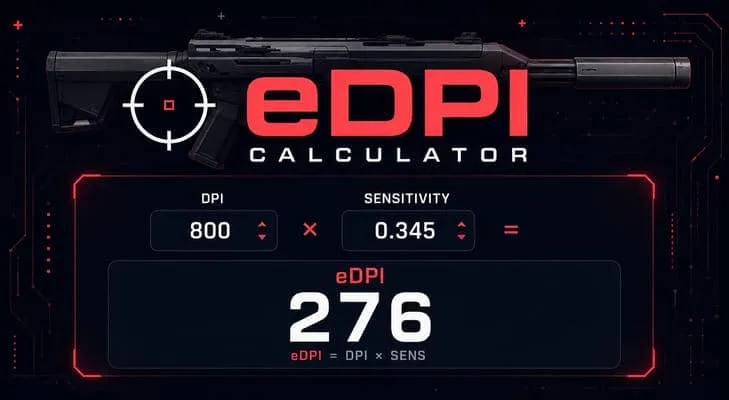
With your sensitivity and DPI properly set, you can play in good conditions. See our article on mouse sensitivity, and our guide to choosing a mouse that fits your hand.
Fatigue and mindset
No surprise to anyone: a tired player will not perform. If you are worn out after a long day, take time to recover before queuing. Fatigue hits your focus, and with it your reflexes and your results.
THE FOUR SKILLS THAT MAKE UP AIM
We talk about aim as if it were a single skill, when it actually bundles four distinct ones. Identifying them lets you work on what you lack instead of repeating what you already know.
Positioning the reticle
Keeping your crosshair at head height and on the angles an enemy can appear from. The most profitable and least spectacular skill: placed well, you barely need to aim anymore.
The quick snap
Bringing the reticle from one point to another in a single motion, when a target appears off your axis. Spectacular, but it is a correction: the better your placement, the less you need it.
Following the target
Keeping the reticle on an opponent strafing sideways. Less decisive in Valorant than in other FPS games, since time to kill is very short, but essential in close-range sprays.
Changing targets
Moving from one opponent to the next without downtime after a kill. It is what separates a player who takes one duel from a player who wins three in a row, and it is the least practiced skill.
If you are starting out, put eighty percent of your effort into crosshair placement and the rest into flicks. Tracking and target switching will come naturally once the first two are in place. Working on flicks before placement is learning to fix a mistake before learning not to make it.
TRAINING AND ROUTINES TO IMPROVE YOUR AIM IN VALORANT
Crosshair placement
To shoot well, the crosshair must always travel the shortest possible distance. Its placement is crucial. See our article on how to improve your crosshair placement.
The crosshair settings themselves (color, size, outlines) remain a personal choice: see our guide to finding your ideal crosshair.
Cheats mode
Use cheats mode to practice without constraints on the game's different maps.
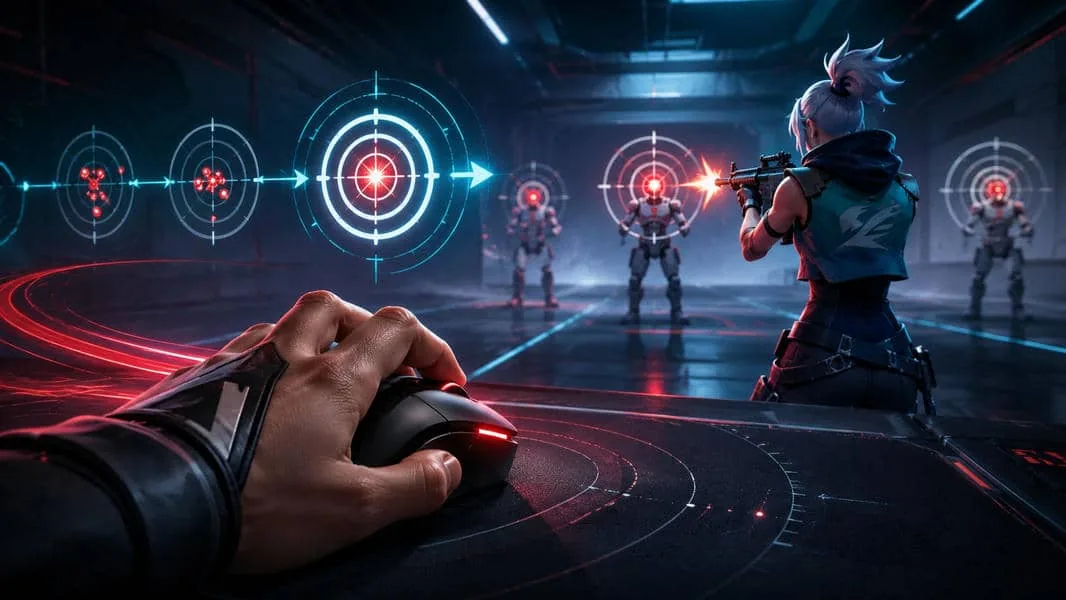
Practice on an aim trainer
Some think it is a bad idea; personally, I believe it is worth doing at any level when you want to fix specific flaws. Concretely, aim trainers help you identify weak points (a weaker left side, a slow hand) and let you work on particular aspects such as speed. They also make a good warm-up before launching the game, waking up your muscle memory.
Track your progress
Without tracking, you never notice your progress: it shows what still needs work, and it feeds the motivation to keep training. Headshot percentage or KDA are useful indicators to follow, along with which agent (or role) gives you your best win rate, and so on.
Which tool for which purpose
The four training environments and what they actually bring.
| Tool | What it is for | Its limit |
|---|---|---|
| Shooting range | Daily warm-up, one-tap precision, recoil control. | Bots do not shoot back: no pressure, no stress. |
| Deathmatch | The closest thing to real conditions: human opponents, duel after duel. | Encourages an aggressive style that is not how ranked games play out. |
| Custom game | Practicing specific angles on a real map, with cheats mode on. | Requires knowing what to work on, or you just go in circles. |
| Aim trainer | Isolating one specific weakness and measuring it, day after day. | Reproduces neither the recoil, nor the movement, nor the geometry of Valorant. |
If you use an external aim trainer, make sure to reproduce your exact Valorant sensitivity in it. Otherwise you are training a muscle memory different from the one you need, and the transfer to the game becomes worthless, even counter-productive.
THE FIFTEEN-MINUTE WARM-UP ROUTINE
A good routine fits in a quarter of an hour and repeats every day. Its value does not come from its length but from its consistency: fifteen minutes a day beat two hours on Saturday.
Before every session
15 minutes- 3 min Shooting range, one shot at a time Medium-difficulty bots, static. One bullet per target, letting the reticle settle between each. The goal is not speed but a clean motion.
- 3 min Moving bots Switch the bots to moving mode and work on tracking. This is the moment to feel whether your sensitivity still suits you.
- 3 min Counter-strafe and dead stop Strafe sideways, stop dead by tapping the opposite key, shoot, move again. The closest exercise to what you will actually do in a match.
- 6 min One Deathmatch Nothing replaces a human opponent who shoots back. Do not chase the score: focus on your crosshair placement and on stopping before you shoot.
Do not queue for ranked right after changing your sensitivity or your reticle. And do not stretch the warm-up past twenty minutes: beyond that, fatigue starts degrading precision instead of improving it. The warm-up prepares the session, it does not replace it.
THE MISTAKES THAT CAP YOUR AIM
Most stuck players do not lack training, they repeat a mistake. Here are the five most common ones.
FREQUENTLY ASKED QUESTIONS
How long does it take to improve your aim?
The first effects of working on crosshair placement show within days, because it is a habit rather than a physical ability. Raw precision improves over several weeks. The deciding factor is not volume but consistency: a daily quarter of an hour beats three hours on the weekend by far.
Do you need a paid aim trainer?
No. Valorant's shooting range and the Deathmatch mode are enough for the vast majority of players, and they have the advantage of reproducing the game's exact weapons, recoil and distances. An external trainer becomes useful once you have identified a specific weakness to isolate and measure, which assumes you already know what you are trying to fix.
Does crosshair placement matter more than raw aim?
Yes, by a wide margin, and it is counter-intuitive. A reticle already sitting at head height on the right angle turns a duel into a simple click. Conversely, the best flick in the world cannot make up for a reticle pointed at the floor when the opponent appears. It is also the fastest skill to improve, since it is a habit.
Which numbers should you track to measure progress?
Three indicators are enough. Headshot percentage, which directly reflects crosshair placement. Average damage per round, more reliable than the kill ratio since it does not depend on who finishes the opponent. And your win rate per agent, which often reveals you climb better with a simple agent than a complex one.
Should you warm up before every ranked game?
Yes, and it is probably the most profitable advice on this page. The first rounds of a session are statistically your worst, because muscle memory is not awake yet. A ten-to-fifteen-minute warm-up moves that fuzzy phase out of the ranked match, where it costs nothing.