


 9 chapters
 Coming from another game?
If you are looking for your sensitivity value coming from another game (CS2, Overwatch, Apex, Call of Duty, Fortnite...), use our sensitivity converter: it reproduces your mouse feel exactly in Valorant.
If you play Valorant, you already know it: your mouse sensitivity has a direct impact on your gameplay. It determines the precision of your aim, the smoothness of your flicks, the steadiness of your tracking and, in the end, your ability to stay consistent match after match.
Valorant is a tactical FPS with a very short time to kill. One Vandal headshot and it is over. In that context, your aim and your crosshair placement are two fundamental skills to build, and it all starts with a proper sensitivity setting.
The goal of this article is simple: help you find YOUR sensitivity. Not a pro player's, not a streamer's, but the one that matches your comfort, your desk space and your style. We will go step by step, with a concrete, accessible method.
There is no universally perfect sensitivity. The best sensitivity is the one you are comfortable and consistent with.
UNDERSTANDING THE BASICS OF SENSITIVITY
DPI, eDPI and in-game sensitivity
Before touching any setting, you need to understand the terms you will meet everywhere. Do not worry, it is simpler than it looks.
DPI (Dots Per Inch) is a hardware setting of your mouse. It defines how many "dots" the sensor reads per inch of movement. The higher the DPI, the faster your cursor moves for the same physical motion. Most gaming mice let you set the DPI, usually between 400 and 3200.
In-game sensitivity is the multiplier Valorant applies to your DPI. It is a software setting you change directly in the game's options.
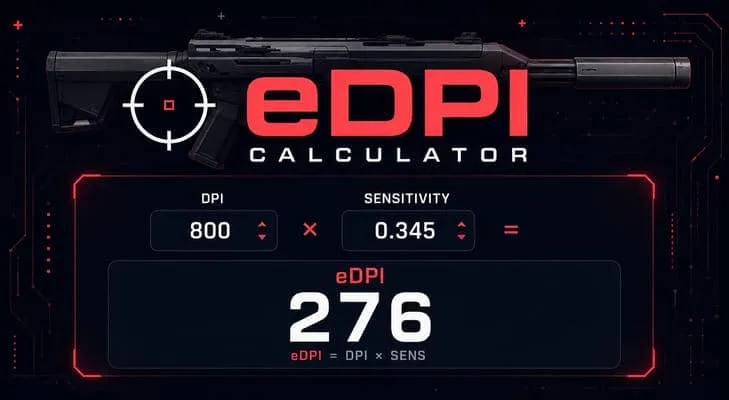
eDPI (effective DPI) is the value that actually matters. It is the product of the two:
For instance, if your mouse is set to 800 DPI and your Valorant sensitivity is 0.35, your eDPI is 280. eDPI is the only value that lets you objectively compare two setups, even when players use different DPIs.
Calculate your eDPI
Type your settings, the result updates liveTHE COMMON SENSITIVITY RANGES IN VALORANT
To give you bearings, here are the broad sensitivity categories in Valorant. These brackets are based on data from hundreds of pro players.
| Category | eDPI range | Example (800 DPI) | Typical profile |
|---|---|---|---|
| Low | 150 to 250 | 0.19 to 0.31 | Arm aimer |
| Medium | 250 to 400 | 0.31 to 0.50 | All-rounder |
| High | 400 to 600 and beyond | 0.50 to 0.75 and beyond | Wrist aimer |
The vast majority of pro players sit in the 200-to-400 eDPI range, with a particular concentration around 250 to 300.
PRO PLAYERS' SENSITIVITIES: A REFERENCE, NOT A TEMPLATE
Looking at pro settings is useful to situate yourself, but keep in mind these players have thousands of hours with their setup. Their sensitivity is the result of years of adjustments, not an arbitrary pick.
| Player | DPI | In-game sens | eDPI | Style |
|---|---|---|---|---|
| TenZ | 1600 | 0.1 | 160 | Arm / very low |
| ScreaM | 400 | 0.73 | 292 | Mixed / medium |
| Aspas | 800 | 0.4 | 320 | Mixed / medium |
| Demon1 | 1600 | 0.1 | 160 | Arm / low |
| Alfajer | 1600 | 0.1125 | 180 | Arm / low |
The average eDPI of Valorant pros sits around 267 according to ProSettings.net data, based on nearly 600 players. Most of them play on low to medium sensitivity.
 Why do most pros play low sens?
Valorant rewards precision over speed. A low sensitivity allows finer micro-adjustments and better crosshair placement control, which is decisive in a game where a single headshot can change everything.
That said, copying a pro's sensitivity without understanding why it suits them is rarely a good idea. TenZ, for one, is known for changing mice and settings frequently. His current setup is the product of his own journey, not a magic formula.
HOW TO FIND YOUR SENSITIVITY: THE STEP-BY-STEP METHOD
Here is a gradual, concrete method to find the sensitivity that fits you. Take the time to follow every step, it is an investment that pays off in the long run.
Step 1: Set your reference DPI
Ideally, set your mouse to 800 DPI. It is the most common reference value, a good balance between comfortable desktop navigation and in-game precision. If your mouse does not offer exactly 800 DPI, take the closest value (750, 1000, and so on). What matters is keeping it fixed, so you can compare and memorize your settings.
Step 2: Pick a starting sensitivity
Launch a practice session and start from a value suited to your profile:
| Your profile | Starting sens (800 DPI) | Matching eDPI |
|---|---|---|
| Arm aimer / precision | 0.25 to 0.35 | 200 to 280 |
| All-rounder | 0.35 to 0.45 | 280 to 360 |
| Wrist aimer / fast | 0.45 to 0.60 | 360 to 480 |
If you have no idea where you stand, start around 0.30 at 800 DPI (eDPI 240). It is a zone that suits many players and gives you room to adjust from there.
Step 3: The dot-tracking test
In the shooting range, aim at a fixed dot on a wall and strafe sideways while trying to keep your crosshair glued to it. The goal is to hold the track for at least 3 seconds without your aim drifting. If you cannot, adjust your sensitivity in small increments of 0.01 to 0.02 either way.
Step 4: The 180° test
An essential test. Place your mouse at the center of your pad, then do a full half-turn (180°) in a single motion. You must be able to do it comfortably, without hitting your wrist's limit or running off the pad. If it is impossible, you are probably too low. If you overshoot 180° by a lot, you may be too high.
Step 5: Deathmatch test
The shooting range is fine, but nothing replaces practice in real conditions. Play a few Deathmatches and assess how it feels on several points: tracking (following a moving enemy), micro-adjustments (correcting onto the head), short flicks (fast target switches) and recoil control. The goal here is not performance but comfort. Your aim must feel like it responds naturally to your intentions.
Step 6: Gradual adjustments
Change your sensitivity in small increments (0.01 or 0.02) and test each new setting for at least 2 to 3 days before judging. Muscle memory needs time to adapt. Above all, avoid changing sensitivity after every bad game: it is the most common trap.
Do not queue for ranked right after changing your settings. Spend time getting used to them in practice and Deathmatch before putting your rank on the line.
LOW VS HIGH SENSITIVITY: PROS AND CONS
Every player uses both arm and wrist, but some aim mostly with the arm (low sensitivity) while others rely more on the wrist (high sensitivity). Here is an honest comparison of the two approaches.
Low sensitivity (eDPI < 250)
- More precision on micro-adjustments and crosshair placement
- Better recoil control
- Greater consistency over time
- Requires a large mousepad
- More physically tiring over long sessions
- Fast turns (180°) demand a big arm motion
High sensitivity (eDPI > 400)
- Fast flicks and easy turns
- Less desk space needed
- Less physically tiring
- Less stability and precision
- Harder to stay consistent under pressure
- Spray control is more difficult
THE MISTAKES TO AVOID
Here are the traps many players fall into when it comes to sensitivity. Avoid them and you are already ahead.
Copying a pro without understanding why
A pro player built their muscle memory over thousands of hours. Their sensitivity is the product of their personal journey, their morphology, their gear and their habits. Using their settings as a starting point is smart. Copying them blindly is counter-productive.
Changing sensitivity after every bad game
The most common mistake. You have a bad game, you decide the sensitivity is the problem, you change it, and your muscle memory starts from scratch. Give yourself at least 3 days with a setting before judging it.
Neglecting the mousepad size
If you play on low sensitivity with a 25 cm pad, you will constantly run off the pad. Invest in a pad that fits your playstyle.
Ignoring posture and comfort
Your sitting position, your desk height, your arm's angle: all of it shapes the way you aim. A sensitivity that works in a good posture can become uncomfortable in a bad one.
Forgetting to disable mouse acceleration
Check that mouse acceleration is disabled in Windows and that Raw Input is enabled in Valorant. Acceleration makes your aim unpredictable by varying the distance the cursor travels depending on how fast you move.
PERSONAL FACTORS TO TAKE INTO ACCOUNT
Your ideal sensitivity depends on many factors that are yours alone. Here are the main ones to consider.
Mousepad size and desk space
The number one physical constraint. A low-sensitivity player needs a pad at least 40 cm wide, ideally 45 cm or more. If your space is limited, a higher sensitivity will be necessary.
Mouse grip type
There are three main grips: palm grip (the whole palm rests on the mouse), claw grip (arched fingers, base of the palm in contact) and fingertip grip (only the fingers touch the mouse). Fingertip and claw players generally find micro-adjustments easier, which can influence the sensitivity choice.
Wrist or arm aiming
As mentioned earlier, some players move mostly the wrist while others use the arm more. Neither approach is better: what matters is that your sensitivity matches your natural style.
Screen resolution
Resolution can influence how sensitivity feels. A lower resolution shows fewer pixels, which can make sensitivity feel slightly different. Most competitive players run 1920 × 1080.
FREQUENTLY ASKED QUESTIONS
What is the best sensitivity for Valorant?
There is no universal best sensitivity. The recommended starting range sits between 200 and 400 eDPI, which matches the zone used by the vast majority of pro players. Start from that bracket and adjust for comfort.
Which eDPI should you use in Valorant?
The pro players' average is around 267 eDPI. For a beginner or intermediate player, starting around 240 to 320 eDPI is generally a good baseline. Then adjust according to how it feels and to your desk space.
Low or high sensitivity to reach Radiant?
Both are viable. Radiant players exist at every sensitivity. That said, most high-level players lean towards low-to-medium eDPI (200 to 400) because Valorant rewards precision. What matters is consistency and mastery of your setup, whichever you pick.
How do you convert your sensitivity from CS2?
Converting between CS2 and Valorant is not a simple 1:1 ratio. The generally accepted multiplier is about 3.18: divide your CS2 sensitivity by 3.18 to get the Valorant equivalent (or multiply your Valorant sens by 3.18 for CS2). For instance, a 1.0 sensitivity at 800 DPI in CS2 is roughly 0.314 in Valorant. To skip the mental arithmetic, our sensitivity converter handles the conversion both ways, from CS2 as well as from Apex, Overwatch, Call of Duty or Fortnite.
Should you pick 400 or 800 DPI?
In-game, there is no difference as long as your eDPI stays the same. A player at 800 DPI with 0.35 sensitivity has exactly the same experience as a player at 400 DPI with 0.70. 800 DPI is often preferred because it gives a smoother cursor in Windows.
Does sensitivity change if I change my mouse?
Yes and no. Your eDPI stays mathematically the same, but the mouse's weight, shape, sensor and skates can change how it feels. If you switch mice, run through the adjustment process in this guide again to check your sensitivity still suits you.
WHAT TO REMEMBER TO FIND YOUR OWN SENSITIVITY IN VALORANT
If there is one thing to take away from this guide, it is that there is no universally perfect sensitivity. The best sensitivity is the one you feel comfortable and consistent with.
Take the time to follow the method in this guide: set your DPI, pick a base suited to your profile, test methodically with the different drills, and above all, give your muscle memory time to adapt. Do not fall into the trap of changing settings after every bad game.
Valorant rewards regularity and consistency. Find your comfort zone, train with it, and the results will follow naturally.
1) Set your DPI (800 recommended) → 2) Pick a base (eDPI 200 to 300) → 3) Dot-tracking test → 4) 180° test → 5) Deathmatch → 6) Gradual adjustments over 2 to 3 days. Good luck and good aim!